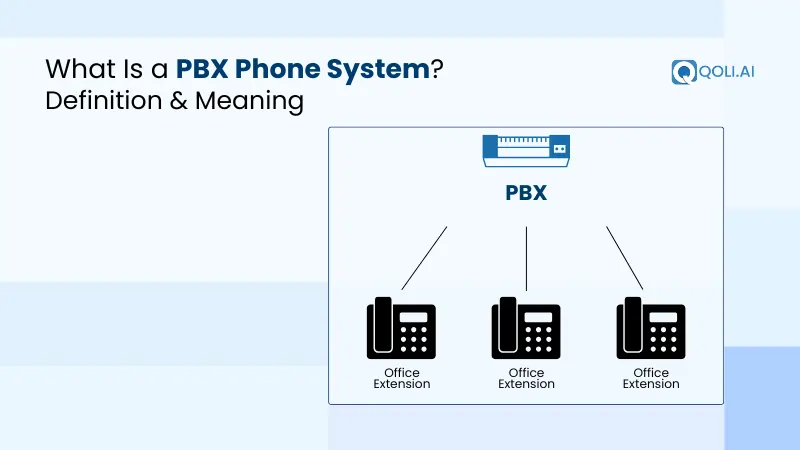
A PBX is a private phone system businesses use to manage internal and external calls. It handles extensions, routing, voicemail, and call management, keeping communication organised and cost-efficient.
Author:Sujith Grandhi
Contents
Thousands are already using Qoli. What are you waiting for?
Follow us on
What Is a PBX Phone System?
A PBX (Private Branch Exchange) phone system is a private telephone network used within a
business or organisation. It connects all employee phones inside the company and also links them to external
phone lines outside the world, allowing multiple employees to make and receive calls efficiently.
A PBX system helps you handle communication easily. You can use extensions, call forwarding, voicemail, and
conference calls from one organised system.
Purpose of a PBX System
A PBX works as the control centre for your business calls. Instead of juggling multiple phone lines, it keeps
everything organised and connected.
Here’s why it’s important for your business:
Connect your team instantly: Employees can call each other without extra lines or hassles.
Route calls the smart way: Incoming calls automatically reach the right person or
department.
Save money: One system handles multiple calls, so you don’t need separate lines for
everyone.
Stay professional: Features like voicemail, auto-attendant, and call transfers make your
business look polished.
Keep it smooth: Multiple calls at the same time? No problem, PBX handles it all seamlessly.
In short, PBX makes your business communication simple, efficient, and professional, so you can focus on growth
instead of phone headaches.
How Does a PBX Work?
A PBX acts like the call manager for your business. It directs every call to the right person or department
without delays or confusion.
Let’s make it simple:
Internal Calls: Your team can call each other easily using extensions, and the best part is
you don’t need separate phone lines for it.
External Calls: PBX connects your office phones to the public network, letting you reach
clients, partners, or suppliers.
Call Routing: Calls automatically go to the right person, department, or even voicemail.
Extra Features: Manage conference calls, transfers, call queues, and voicemail
effortlessly.
Types of PBX Systems
Not all PBX systems are built the same, different businesses have different needs. Some prefer having everything
on-site, others want the flexibility of the cloud, and some need a mix of both. Let’s break down the main types
of PBX systems so you can see which one fits your business style best:
1. Traditional / On-Premises PBX
This is the classic PBX setup. All the hardware is installed on-site at your office, and you have full control
over it. It’s reliable and works even if the internet goes down, but it does require maintenance, upgrades, and
sometimes extra staff to manage it.
Best For: Companies wanting lower costs without losing call quality.
2. IP PBX
An IP PBX uses the internet (VoIP) to make and receive calls instead of traditional phone lines. It’s flexible,
cost-efficient for long-distance calls, and allows features like mobile integration or connecting multiple
offices easily. Perfect for companies looking to cut costs without losing quality.
Best For: Companies wanting lower costs without losing call quality.
3. Cloud / Hosted PBX
A cloud PBX is hosted by a service provider, so you don’t need any physical hardware at your office. It’s easy
to set up, works from anywhere, and is great for remote teams. You just need a stable internet connection. It’s
ideal for businesses that want simplicity, scalability, and minimal IT hassle.
Best For: Teams that want scalability, mobility, and minimal IT work.
4. Hybrid PBX
Hybrid PBX combines the best of both worlds, part on-premises and part cloud. You can keep critical systems
on-site while taking advantage of cloud features like remote access, scalability, or advanced analytics. Great
for businesses that want flexibility and control at the same time.
Best For: Businesses that need both control and flexibility.
Key Features of PBX Systems
A PBX system goes beyond basic calling and gives your business a structured way to
manage communication.
Auto-Attendant / IVR: Greets and guides callers automatically.
Call Forwarding & Transfer: Direct calls to the right person quickly.
Voicemail & Voicemail-to-Email: Never miss important messages.
Extensions & Ring Groups: Organize your team by departments or functions.
Conference Calling: Bring multiple people together in one call.
Call Recording & Analytics: Track calls for quality or training purposes.
Benefits of PBX in Business
When you’re running a business, every call matters, how fast you answer it, how smoothly it gets routed, and how
professional you sound. That’s where a PBX system really helps. Here’s why so many businesses depend on it:
Save Costs: Share lines and cut down long-distance expenses.
Look Professional: Automated features improve customer experience.
Scale Easily: Add users or extensions as your business grows.
Work Anywhere: Cloud and IP PBX let your team work remotely.
Integrate Seamlessly: Connect PBX with CRM and other tools for efficiency.
How to Choose the Right PBX System for Your Business
Choosing a PBX doesn’t have to be complicated. Ask yourself:
What do I need? Size of team, call volume, future growth.
Which type fits best? On-premises, IP, cloud, or hybrid?
Which features matter most? List must-haves vs nice-to-haves.
What’s the budget? Compare setup costs, subscriptions, and TCO.
Is support reliable? Make sure help is available and secure.
Will it be dependable? Check call quality, uptime, and internet reliability if cloud-based.
With the right PBX system in place, your business communication becomes clearer, faster, and easier to manage.
Visweswara Sujith Kumar Grandhi is a content writer and tech enthusiast who turns fresh ideas
into content that connects. He’s always exploring new digital trends. Outside writing, he enjoys
listening to music, exploring new places, and thinking up ideas, with his phone never too far
away. He brings curiosity and energy to every team he joins.
Want 30% Off? Act Fast!
Last chance! Get 30% off all Qoli features before this limited-time deal disappears forever.